guides10 min read
Birth Chart Guide: Get Your Natal Chart Instantly
Natal AI Team(Astrology & AI Research)•
👉 Want your chart right now? Try the free Birth Chart Calculator — instant full natal chart from your birth date, time, and place. No signup required.
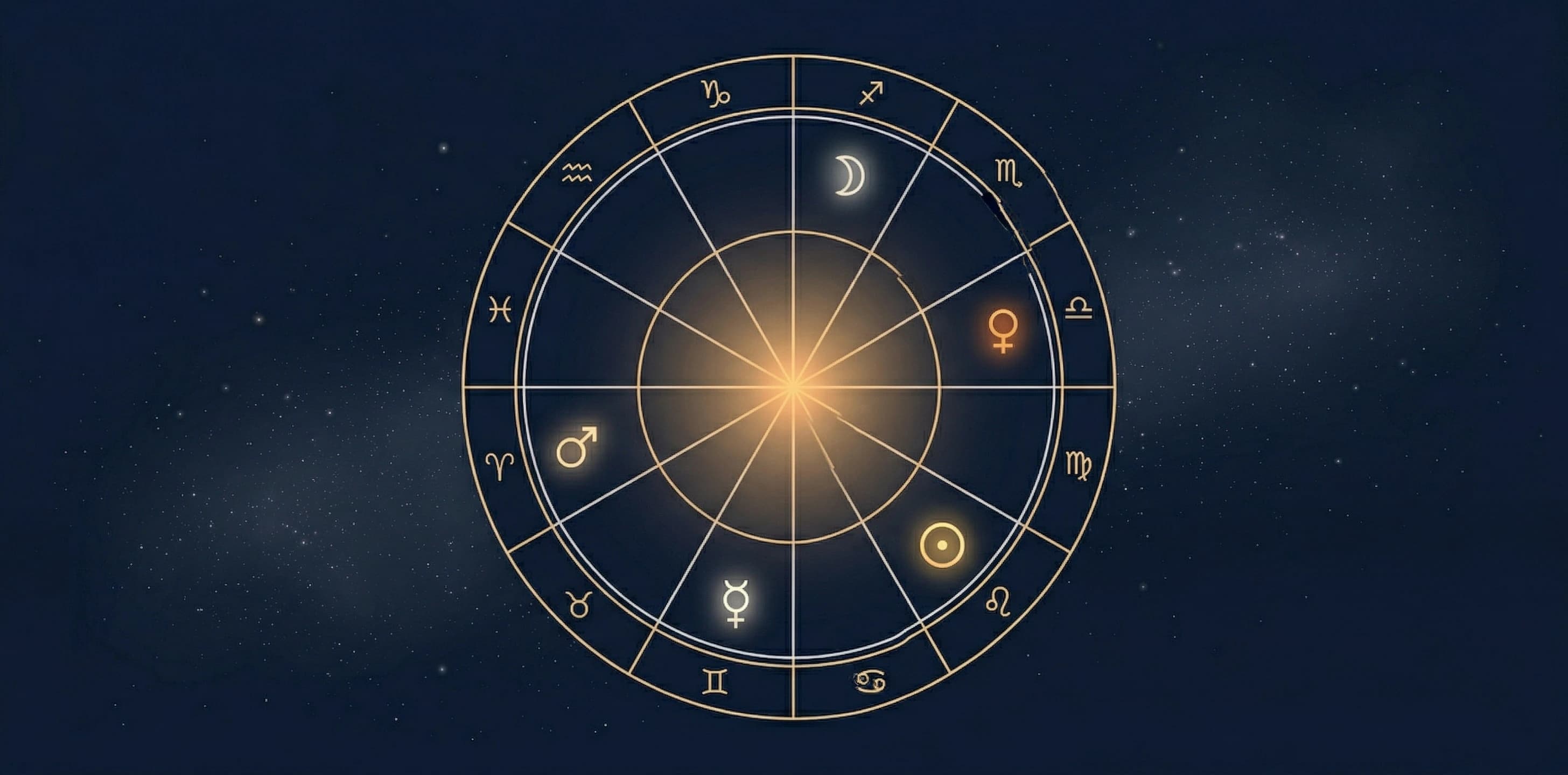
A birth chart calculator computes the exact position of every planet at the moment you were born and maps them across the 12 zodiac signs and 12 astrological houses. It is the most precise astrological tool available — far more specific than a sun-sign horoscope, which applies to roughly 1/12 of the world's population.
This guide explains what a birth chart calculator shows you, what separates good calculators from basic ones, and how to get the most from your results.
A complete birth chart calculator generates four layers of information:
Planetary positions — where the Sun, Moon, Mercury, Venus, Mars, Jupiter, Saturn, Uranus, Neptune, and Pluto fall by zodiac sign. These determine your core personality traits, emotional patterns, communication style, and more.
House placements — which of the 12 houses each planet occupies. Houses represent life areas like career, relationships, home, and creativity. A Venus in the 10th house (career) expresses very differently from a Venus in the 4th house (home and family).
Aspects — the geometric angles between planets, revealing how different parts of your personality work together or create tension. A Moon trine Jupiter suggests emotional generosity, while a Moon square Saturn points to emotional restraint. For a full breakdown, see our natal chart aspects guide.
Rising sign (ascendant) — the zodiac sign on your eastern horizon at birth. Your rising sign determines your 1st house and shifts all other house placements. It shapes how others perceive you and your instinctive approach to new situations. Learn more about your Sun, Moon, and Rising signs.
Together, these layers create a portrait that applies only to people born at your exact time and place — your astrological fingerprint.
Three pieces of information determine your chart's accuracy. For a deeper explanation of each, see our complete birth chart reading guide.
Your birth date determines the positions of all planets, especially your Sun sign and the slow-moving outer planets (Jupiter through Pluto). This is the minimum requirement for any chart.
Your exact birth time is the most critical input. It determines your rising sign, which changes approximately every two hours, and sets the entire house system of your chart. Check your birth certificate — most include the time. If yours does not, contact the hospital or vital records office where you were born.
Your birth location (city and country) is needed to calculate the local horizon at your birth moment. Two people born at the same minute but in different cities will have different rising signs and house placements because the sky looks different from each location.
Not all birth chart calculators give you the same experience. They fall into three categories:
| Feature | Basic Calculator | Report Generator | AI-Powered Calculator |
|---|---|---|---|
| Chart generation | Yes | Yes | Yes |
| House system shown | Sometimes | Yes | Yes (Placidus default) |
| Planetary positions | Degrees only | Degrees + signs | Full context |
| Interpretation | None | Pre-written text per placement | AI synthesis of multiple placements |
| Follow-up questions | No | No | Yes, conversational |
| Personalization | Minimal | Individual placements | Integrated chart reading |
| Cost | Free | Free to $15/month | Free tier available |
| Best for | Quick lookup | Static reference | Learning and exploring your chart |
Basic calculators show you where your planets are, but leave interpretation entirely to you. Useful if you already know how to read a chart, but not helpful for beginners.
Report generators look up each placement and serve a pre-written paragraph. Everyone with the same Venus sign gets identical text. This is how most astrology apps work, even those that market themselves as "AI-powered." For more on how to evaluate these claims, read whether AI astrology is actually accurate.
AI-powered calculators consider how your placements interact with each other. Your Venus in Scorpio in the 10th house with a trine to Pluto tells a very different story than Venus in Scorpio in the 4th house square Saturn. AI synthesis handles that distinction. For a detailed comparison of the best tools, see our guide to the best birth chart AI chatbots in 2026.
The house system determines how the 12 houses are divided across your chart. Placidus is the standard in Western astrology and the system taught in most professional courses. Some calculators default to less common systems like Porphyry without telling you, which can shift your house placements entirely. Always check which system your calculator uses. For a full comparison of house systems, see the house systems section in our birth chart reading guide.
The critical question: does the tool synthesize your placements together, or does it serve isolated text snippets? Template matching gives everyone with the same placement identical text. AI synthesis considers how your Venus interacts with your Moon, your 7th house ruler, relevant aspects, and current transits — then generates a response unique to your chart.
Test any tool by asking a question that requires combining multiple placements. If the answer could apply to anyone with your Sun sign, it is template matching.
Birth data is personally identifiable information — your exact birth date, time, and location. Look for calculators that encrypt your data, do not require a phone number, and let you delete your information at any time. Avoid tools that do not disclose how they handle your data.
Behind every birth chart calculator is a five-step process:
You enter your birth data — date, time, and location. The location is converted to geographic coordinates (latitude and longitude) for astronomical calculation.
Ephemeris lookup — the calculator queries an astronomical ephemeris (most use the Swiss Ephemeris, the same dataset professional astrologers rely on) to determine the exact position of each planet at your birth moment.
House system calculation — using your birth time and location, the calculator determines which zodiac sign sits on the cusp of each of the 12 houses. Your rising sign (the sign on the 1st house cusp) anchors the entire system.
Aspect calculation — the calculator computes the geometric angles between every pair of planets. Aspects like conjunctions (0 degrees), trines (120 degrees), and squares (90 degrees) reveal how different planetary energies interact in your chart.
Chart rendering — your natal chart is displayed as a wheel diagram or table showing all planetary positions, house placements, and aspects. Some tools also generate a visual chart graphic.
The calculation layer is mathematically precise — Swiss Ephemeris data is accurate to fractions of a degree. Where calculators diverge is in interpretation: what they do with those positions after computing them.
Each planet in your chart governs a specific dimension of your personality and life experience:
| Planet | What It Reveals | Example Interpretation |
|---|---|---|
| Sun | Core identity and life purpose | Sun in Aries: bold, independent, action-oriented |
| Moon | Emotional needs and instincts | Moon in Cancer: nurturing, security-focused, deeply empathetic |
| Mercury | Communication and thinking style | Mercury in Gemini: quick-witted, versatile, curious communicator |
| Venus | Love style and values | Venus in Scorpio: intense loyalty, deep emotional connections |
| Mars | Drive and assertiveness | Mars in Capricorn: disciplined ambition, strategic in action |
| Jupiter | Growth and opportunity | Jupiter in 9th house: expansion through travel, philosophy, education |
| Saturn | Discipline and challenges | Saturn in 7th house: serious approach to partnerships and commitment |
| Uranus | Innovation and change | Uranus in 4th house: unconventional home life, need for domestic freedom |
| Neptune | Imagination and spirituality | Neptune in 10th house: creative or unclear career path |
| Pluto | Transformation and power | Pluto in 1st house: intense presence, cycles of personal reinvention |
The Sun through Mars are personal planets — they move quickly and describe your individual personality. Jupiter and Saturn are social planets, bridging the personal and collective. Uranus, Neptune, and Pluto are generational planets — their sign placement is shared by entire age groups, but their house placement is unique to you.
These placements do not operate in isolation. A Moon in Cancer square Saturn reads very differently from a Moon in Cancer trine Jupiter. The aspects between planets are what make your chart dynamic — turning a list of positions into a living system. Understanding how your Big Three interact is the best starting point.
Current planetary transits also activate different parts of your natal chart over time, which is why the same chart can feel different at different life stages.
Generating your birth chart is step one. The real value comes from understanding what it means — and that is where AI interpretation changes the experience.
Instead of reading a static report, you can have a conversation with an AI that knows your full chart:
An AI-powered reading considers your Venus sign alongside your 7th house ruler, your Moon sign, relevant aspects, and current transits — then generates a response that integrates all of those factors. This is closer to sitting across from a professional astrologer than reading a template-generated report.
For a detailed walkthrough of how AI birth chart readings work and what to expect, see our guide to getting an AI-powered birth chart reading.
Natal AI calculates your birth chart using the Placidus house system — the professional standard in Western astrology. Enter your birth date, time, and location to see your full chart with planetary positions, house placements, and aspects.
The AI chatbot interprets your chart conversationally. Ask follow-up questions about any placement, track current transits, or explore compatibility with a partner. No per-question charges.
Your birth data is encrypted and never shared.
Already have an account? Go to AI chat
For pricing details, visit our pricing page.
Want to understand your chart from the ground up? Start with our complete birth chart reading guide or learn what your Sun, Moon, and Rising signs reveal about you.