learn5 min read
Synastry Charts Explained: How to Check Astrological Compatibility
Natal AI Team(Astrology & AI Research)••Updated March 15, 2026
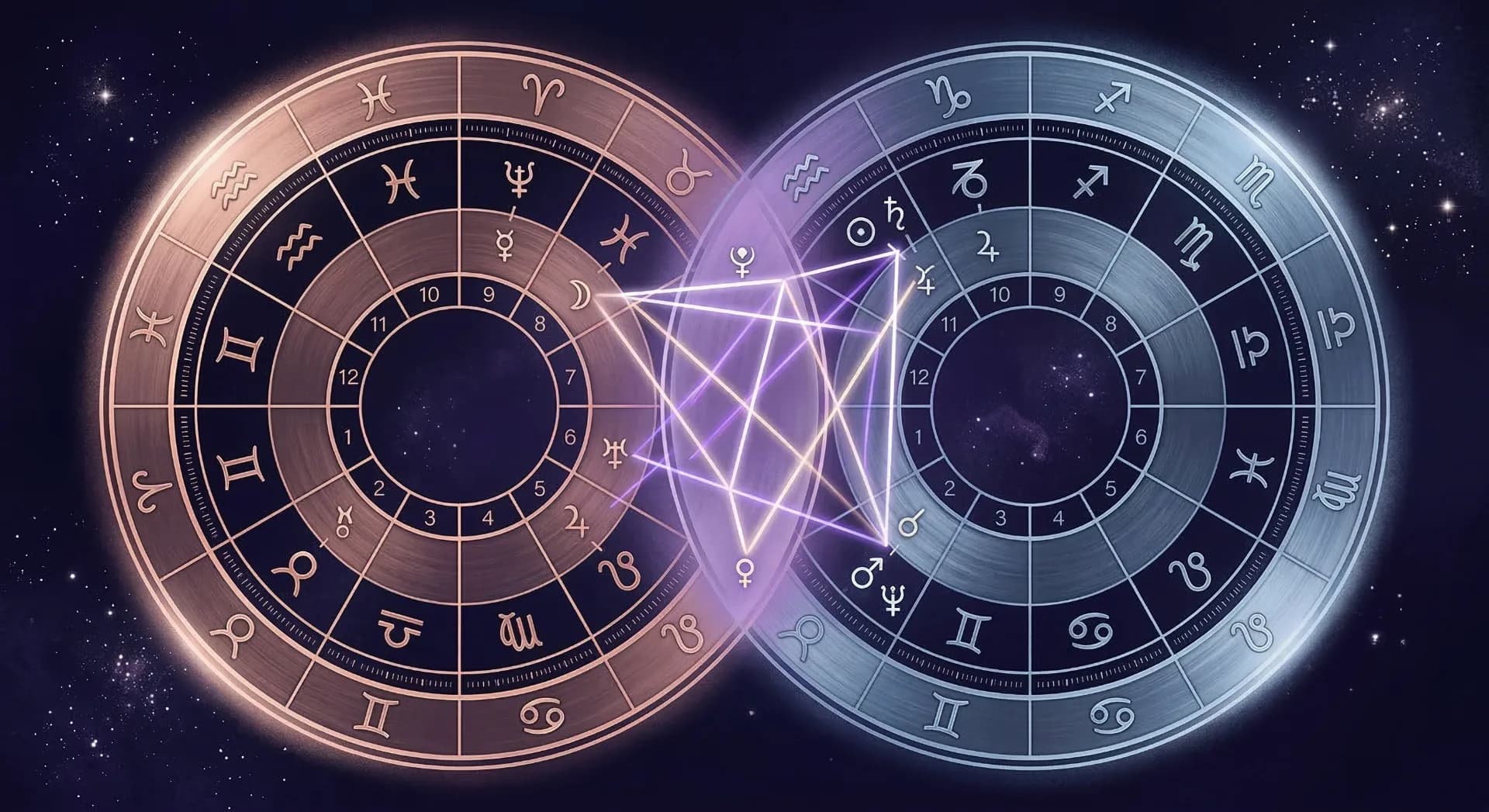
Synastry is the astrological technique for comparing two birth charts to understand how two people interact. It goes far beyond sun sign compatibility tables — it examines how every planet in your chart relates to every planet in someone else's, revealing the specific dynamics of attraction, conflict, comfort, and growth between you.
A synastry chart places two natal charts on top of each other and examines the aspects (angles) between one person's planets and the other's. If your Venus lands on your partner's Mars, there is a Venus-Mars conjunction in synastry — one of the strongest indicators of physical attraction.
Every aspect tells a different story. Some create ease and flow. Others create friction and intensity. A real relationship typically has both, and understanding the pattern helps explain why certain dynamics keep showing up.
These are two different techniques that answer different questions:
| Method | What It Shows | Best For |
|---|---|---|
| Synastry | How each person affects the other individually | Understanding attraction, triggers, and growth areas |
| Composite | The relationship as a single entity | Understanding the relationship's purpose and shared identity |
Synastry asks: "How does Person A experience Person B, and vice versa?" The experience is not always symmetrical — you might feel intensely drawn to someone who experiences you as stabilizing rather than exciting.
Composite asks: "What is this relationship about as a unit?" The composite chart has its own Sun, Moon, and placements that describe the relationship's character.
Both are valuable. Synastry is usually the starting point because it explains the felt experience of being with someone.
What they indicate: Physical attraction, romantic chemistry, desire.
Venus-Mars aspects are the classic indicators of romantic and sexual chemistry. The conjunction (0°) is the most potent — when one person's Venus sits on the other's Mars, the attraction is usually immediate and obvious.
Venus-Mars contacts do not guarantee emotional compatibility, but they explain why certain people feel magnetically drawn to each other.
What it indicates: Emotional security, domestic harmony, nurturing patterns.
Moon contacts in synastry reveal how emotionally safe you feel with someone. They are often more important for long-term relationship satisfaction than Venus-Mars aspects.
What they indicate: Commitment, durability, responsibility — but also potential restriction.
Saturn in synastry gets a bad reputation, but it is one of the most important indicators for whether a relationship lasts. Saturn contacts create a sense of obligation and mutual investment that keeps people together through difficulty.
Relationships with no Saturn contacts often lack staying power. Relationships with only Saturn contacts can feel heavy. The ideal is Saturn contacts alongside Venus-Mars chemistry and Moon compatibility. For a deeper understanding of how these planetary aspects work, see our aspects guide.
No single aspect is a dealbreaker, but these patterns warrant awareness:
Remember: difficult aspects do not doom a relationship. They highlight areas that require conscious effort. Many of the most growth-oriented, long-lasting relationships have prominent squares and oppositions.
To analyze synastry between you and another person:
The interpretation is where it gets nuanced. A Venus-Mars square combined with a Moon-Moon trine tells a different story than a Venus-Mars trine with a Moon-Saturn square.
Understanding each person's Big Three is an essential starting point — the interplay between your Sun, Moon, and Rising signs often reveals the initial dynamic. For a deeper context, consider how planetary transits are currently affecting each person's chart, as transits can activate or soften synastry dynamics.
If you want to explore compatibility with a partner, friend, or colleague, Natal AI's chatbot can analyze synastry between two charts. Enter both birth dates and ask specific questions about how your charts interact.
For a foundation in reading your own chart first, start with our birth chart reading guide or learn about your Sun, Moon, and Rising signs. To understand the houses that each person's planets activate, check our houses guide.