guides7 min read
Natal Chart Aspects: Conjunctions, Squares, Trines, and More
Natal AI Team(Astrology & AI Research)••Updated March 15, 2026
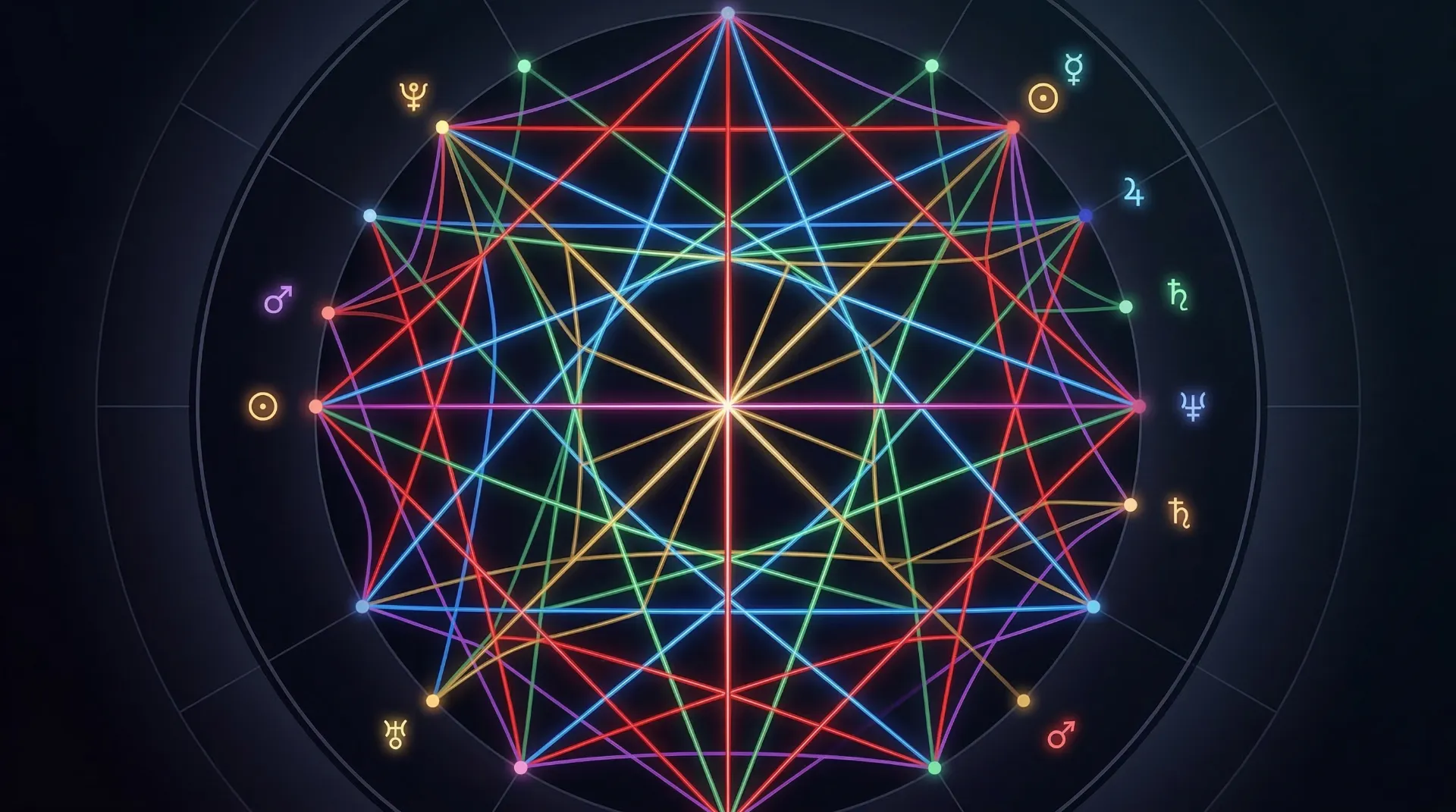
Knowing your planetary placements tells you what energies are present in your chart. Aspects tell you how those energies interact. A chart without aspects would be a collection of unrelated traits. With aspects, it becomes a dynamic system where different parts of your personality support, challenge, and transform each other.
An aspect is a specific angular relationship between two planets. When two planets are a meaningful number of degrees apart, they form an aspect — a connection that blends their energies in a particular way.
The angle determines the quality of the interaction:
Aspects are not exact to the degree in most charts. An orb (allowance of a few degrees) is applied. A trine at 118° or 123° still counts — the tighter the orb, the stronger the aspect.
Two planets at the same degree merge their energies. The conjunction is the most powerful aspect because neither planet can express itself independently — they are fused.
The quality depends entirely on the planets involved:
| Conjunction | Expression |
|---|---|
| Sun-Moon | Unified personality — your identity and emotional needs are aligned. New Moon birth. |
| Venus-Mars | Magnetic charm, strong romantic and creative energy, passion is central to identity |
| Mercury-Saturn | Disciplined, careful thinking; may tend toward pessimism or mental rigidity |
| Mars-Pluto | Enormous willpower and intensity; drive can become obsessive or dominating |
| Jupiter-Neptune | Idealism, spiritual expansion, creative vision; can lack boundaries or practicality |
Conjunctions amplify. A Venus-Jupiter conjunction amplifies love, generosity, and indulgence. A Saturn-Pluto conjunction amplifies control, ambition, and the capacity for enduring difficult circumstances.
Sextiles connect planets in compatible elements (fire-air or earth-water) and create natural talent and opportunity. They are gentler than trines — the talent is there, but it usually requires some conscious activation to use.
Example: Mercury sextile Venus gives communication charm and social grace. The person can be witty and persuasive, but may need to develop the skill rather than having it flow automatically.
Sextiles are often overlooked in chart readings because they are subtle. They represent doors that are easy to open — if you notice them.
Squares connect planets in incompatible elements and create internal friction. Two parts of your personality are working at cross purposes, generating tension that demands resolution.
| Square | The Tension |
|---|---|
| Moon square Mars | Emotional needs conflict with desire for action; reactive temper, emotional impulsiveness |
| Venus square Saturn | Love feels restricted or delayed; fear of vulnerability, high standards that are hard to meet |
| Sun square Pluto | Identity struggles with control and power; intense self-transformation, possible ego conflicts |
| Mercury square Neptune | Logical thinking clouded by imagination; creative but prone to confusion or self-deception |
Squares are the engine of personal growth. They create discomfort that motivates change. A person with no squares may coast through life without the friction that drives achievement. The most accomplished people typically have prominent squares in their charts.
Trines connect planets in the same element (fire-fire, earth-earth, etc.) and create natural, effortless ability. The energy flows so smoothly that the person may not even recognize it as a talent — it feels normal to them.
Example: Moon trine Jupiter gives emotional generosity, natural optimism, and an instinctive ability to make others feel good. The person does this without trying and may not realize it is a gift.
The downside of trines is complacency. Because the energy flows without effort, trine-dominant charts can produce people who never develop their gifts because nothing pushes them to do so. Trines are potential; squares are what force you to develop that potential.
Oppositions connect planets in opposing signs and create a seesaw dynamic. The two energies are aware of each other but tend to swing between extremes rather than integrating smoothly.
| Opposition | The Polarity |
|---|---|
| Sun opposite Moon | Identity and emotional needs pull in different directions; full Moon birth |
| Venus opposite Pluto | Love swings between intimacy and control; intense attraction with power dynamics |
| Mars opposite Saturn | Desire for action blocked by caution; frustration alternating with discipline |
| Mercury opposite Jupiter | Detail thinking vs. big picture; tendency to overcommunicate or overpromise |
Oppositions are about learning to hold both poles simultaneously rather than swinging between them. They often play out in relationships — you may attract partners who embody the planet you are less comfortable expressing.
Beyond the five major aspects, several minor aspects add nuance:
| Aspect | Angle | Quality | Meaning |
|---|---|---|---|
| Semi-sextile | 30° | Mildly irritating | Planets in adjacent signs; subtle discomfort, adjustment needed |
| Quincunx (Inconjunct) | 150° | Awkward | Two energies that have nothing in common; requires creative integration |
| Semi-square | 45° | Mildly tense | A softer version of the square; irritation that builds over time |
| Sesquiquadrate | 135° | Mildly tense | Similar to semi-square; friction that demands minor adjustment |
| Quintile | 72° | Creative | Talent and creative ability; often overlooked but significant for artistic expression |
The quincunx deserves special attention. It connects signs that share no element, modality, or polarity — they have literally nothing in common. Managing a quincunx requires constant adjustment, like trying to satisfy two completely unrelated needs simultaneously. Health issues are sometimes linked to quincunx aspects in the natal chart.
When reading your chart's aspects, prioritize:
The chart ruler's aspects deserve extra attention. Your chart ruler is the planet that rules your rising sign. Its aspects describe core life themes that run through everything you do.
No. The language of "hard" (squares, oppositions) versus "soft" (trines, sextiles) aspects is misleading. A more accurate framing:
A chart dominated by harmonious aspects can produce a person who is gifted but unmotivated. A chart dominated by dynamic aspects can produce a person who achieves enormously through sheer drive born from internal tension.
The ideal chart — to the extent one exists — has a balance of both. And the real question is not whether an aspect is "good" or "bad" but how consciously you work with its energy.
For a comprehensive reference on how aspects interact with houses and planets, see our birth chart reading guide. To understand how transiting planets form temporary aspects to your natal chart, read our transits guide. To explore the specific aspects in your chart and what they mean for you, ask the Natal AI chatbot.