learn6 min read
Understanding Planetary Transits: What They Mean for You
Natal AI Team(Astrology & AI Research)••Updated March 15, 2026
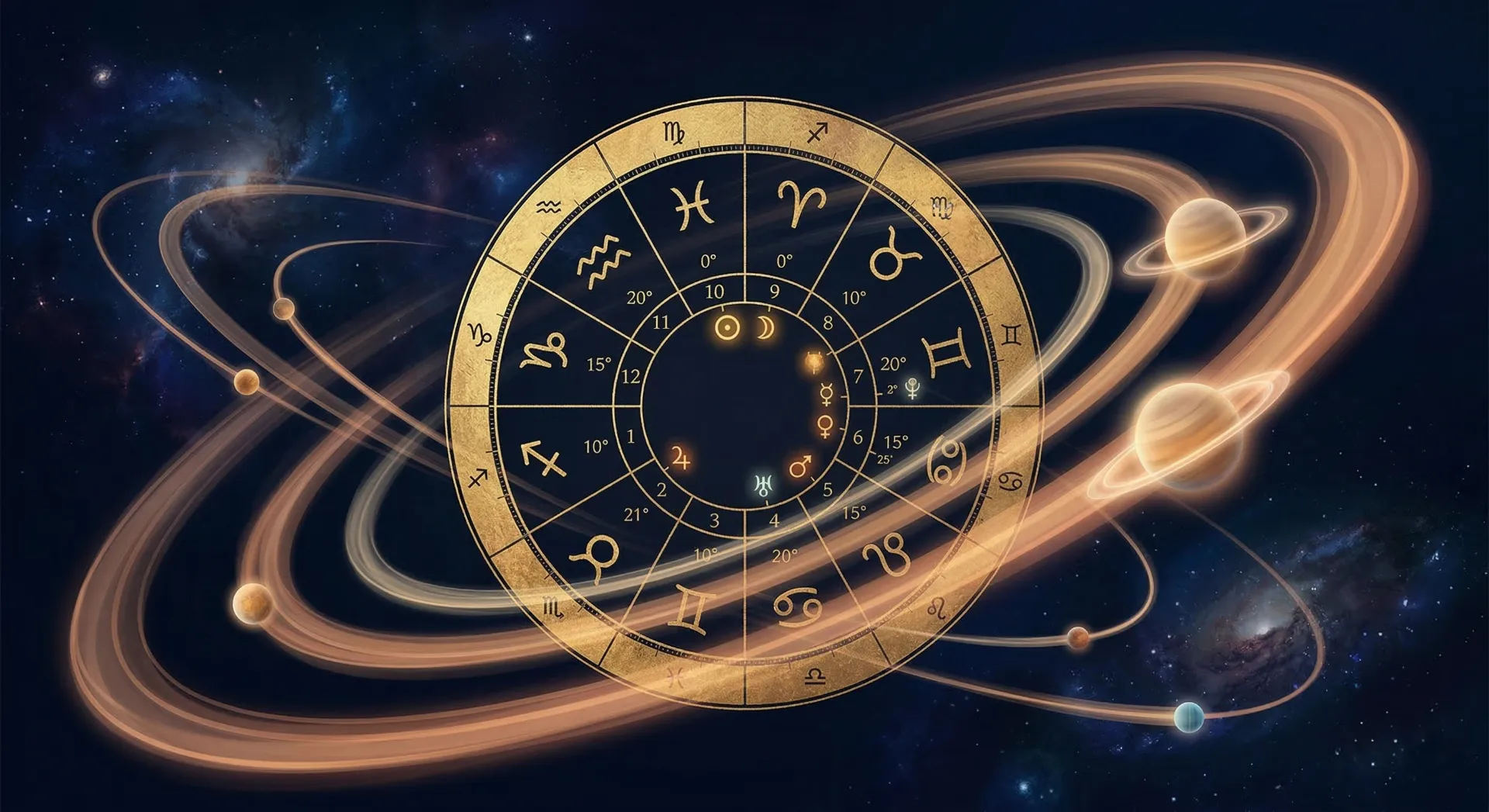
Your birth chart is a fixed map. It never changes. But the planets keep moving — and when their current positions form significant angles to your natal placements, you experience what astrologers call transits. Transits are the astrological weather report for your chart. They explain why certain periods of your life feel expansive and others feel constrictive, even when nothing obvious has changed externally.
A transit happens when a planet's current position in the sky forms an aspect to a planet or point in your birth chart. If transiting Jupiter is at 15° Taurus and your natal Sun is at 15° Virgo, you are experiencing a Jupiter trine Sun transit — a period of expansion, confidence, and opportunity related to your core identity.
The slower the transiting planet, the more significant the transit:
| Planet | Time Per Sign | Transit Duration | Impact Level |
|---|---|---|---|
| Moon | ~2.5 days | Hours | Mood, daily energy |
| Sun | ~30 days | 1-2 days | Short energy shifts |
| Mercury | ~3 weeks | Few days | Communication, thinking |
| Venus | ~4 weeks | Few days to 1 week | Relationships, pleasure |
| Mars | ~6 weeks | 1-2 weeks | Drive, conflict, action |
| Jupiter | ~1 year | Several months | Growth, opportunity |
| Saturn | ~2.5 years | 1-2 years | Discipline, restructuring |
| Uranus | ~7 years | 2-3 years | Disruption, liberation |
| Neptune | ~14 years | 3-5 years | Dissolution, spirituality |
| Pluto | ~12-30 years | 5-10+ years | Transformation, power |
Fast planets (Moon through Mars) create the daily texture of life. Slow planets (Jupiter through Pluto) mark the major chapters.
A transit is not just about the transiting planet — it is about the conversation between the transiting planet and your natal placement. Transiting Saturn over your natal Venus is fundamentally different from transiting Saturn over your natal Mars.
The house the transit activates matters too. Saturn crossing your 10th house cusp (Midheaven) triggers career restructuring. The same Saturn crossing your 4th house cusp triggers home and family changes. Same planet, same energy, different life area.
Certain transits happen to everyone at roughly the same age because the outer planets follow predictable cycles. These are the universal astrological milestones.
The Saturn return is the most discussed transit in astrology for good reason. It occurs when transiting Saturn completes a full orbit and returns to the exact degree it occupied at your birth — around age 28-30.
The first Saturn return marks the transition from youth to adulthood. Structures built in your 20s are tested: careers, relationships, living situations, identities. What is built on solid ground survives. What is not gets restructured — sometimes voluntarily, sometimes forcefully.
Common first Saturn return experiences:
The second Saturn return (~58-60) is a maturity review. The third (~86-88) is about legacy.
The Saturn return lasts approximately 2-3 years total (Saturn is in the same sign for ~2.5 years). The peak is when Saturn is within 1-2 degrees of your natal Saturn.
Jupiter returns to its natal position approximately every 12 years (ages ~12, 24, 36, 48, 60, etc.). Jupiter returns bring expansion, opportunity, and renewed optimism in the house and sign where your natal Jupiter sits.
The Jupiter return at ~24 often coincides with educational completion and early career expansion. At ~36, it frequently brings a period of professional growth or philosophical broadening. These transits are generally experienced as positive, though Jupiter can also bring excess — overcommitting, overconfidence, or expanding in unsustainable ways.
Between ages 36-48 (varying by generation due to Pluto's irregular orbit), transiting Pluto forms a square to your natal Pluto. This is the midlife transit — a period of deep psychological transformation where power dynamics, control patterns, and suppressed material demand attention.
This transit often coincides with what people call a "midlife crisis," though it is more accurately a midlife transformation. Structures of power and identity that no longer serve you become intolerable. The transit demands authenticity.
To know what transits are affecting you now:
The most impactful transits involve slow planets aspecting your personal planets (Sun, Moon, Mercury, Venus, Mars) or chart angles (Ascendant, Midheaven). A Pluto transit to your natal Sun is life-altering. A Pluto transit to your natal Uranus (a generational planet) is barely noticeable personally.
Natal AI's chatbot can identify your current transits and explain what they mean specifically for your chart. Ask something like "What major transits am I experiencing right now?" and the AI will cross-reference current planetary positions with your natal placements.
For the foundational knowledge of what is in your natal chart, start with our birth chart reading guide. To understand how transit aspects work, see our aspects guide. If you are exploring how transits affect your relationships, our synastry guide covers how two charts interact.