guides10 min read
Birth Chart Reading: Your Complete Guide to Understanding Your Natal Chart
Natal AI Team(Astrology & AI Research)••Updated March 15, 2026
Your birth chart is the most detailed astrological tool available to you. Unlike daily horoscopes that lump millions of people into 12 categories, a birth chart maps exactly where every planet was at the precise moment and location of your birth. This guide explains how to read one from scratch.
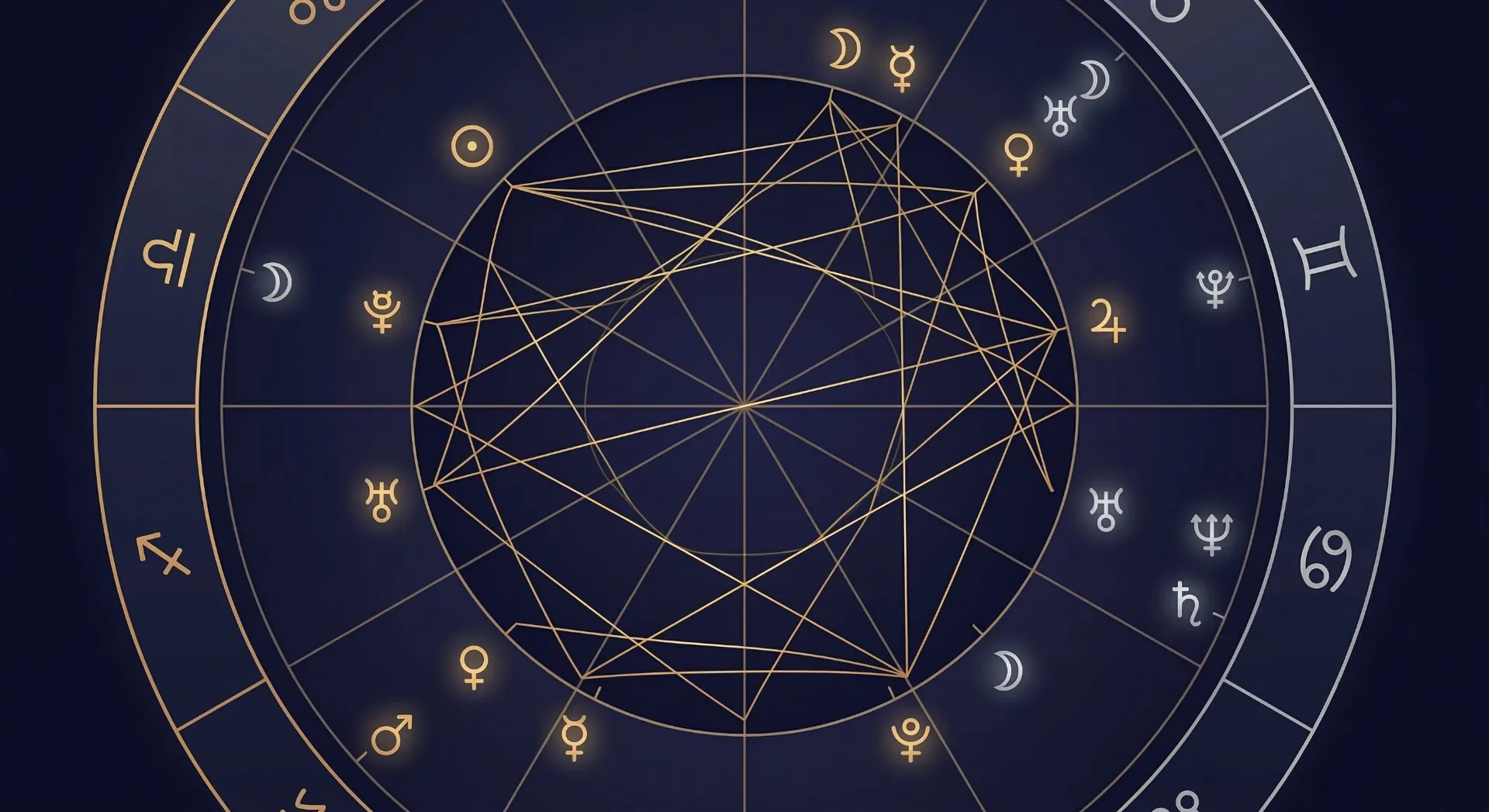
A birth chart — also called a natal chart — is a circular map of the sky frozen at the moment you were born. It shows the positions of the Sun, Moon, Mercury, Venus, Mars, Jupiter, Saturn, Uranus, Neptune, and Pluto across the 12 zodiac signs and 12 astrological houses.
Think of it as your astrological fingerprint. While you share your Sun sign with roughly 1/12 of the world's population, the full combination of planetary positions, house placements, and aspects in your chart is unique to people born at your exact time and place.
The chart itself is a wheel divided into 12 sections (houses), with planetary symbols placed at the degree positions they occupied at your birth. Each element carries specific meaning.
Three pieces of information determine your chart's accuracy.
Your birth date determines the positions of all planets, especially the slow-moving outer planets (Jupiter through Pluto) and your Sun sign. This is the minimum requirement for any chart.
Your exact birth time is critical. It determines your rising sign (ascendant), which changes approximately every two hours, and sets the entire house system of your chart. Without it, your Sun sign, Moon sign, and planetary aspects remain accurate, but house placements and your rising sign will be unknown or approximate.
Check your birth certificate — most include the time. If yours does not, contact the hospital or vital records office where you were born.
Your birth location (city and country) is needed to calculate the local horizon at your birth moment. Two people born at the same minute but in different cities will have different rising signs and house placements because the sky looks different from each location.
Reading a chart can feel overwhelming at first. Break it into layers.
Your Big Three are the foundation of your chart:
Together, these three placements give a far more complete picture than your Sun sign alone.
After your Big Three, look at where each planet falls by sign:
The outer planets (Uranus, Neptune, Pluto) move slowly and are shared by entire generations, so their sign placement is less personal. Their house placement, however, is unique to you.
Each planet sits in a house as well as a sign. The house tells you which life area that planet's energy expresses through. A Venus in the 10th house (career) manifests very differently from a Venus in the 4th house (home and family), even if both are in the same zodiac sign.
Aspects are the angles between planets. They reveal how different parts of your personality work together or create tension. A Moon square Saturn, for example, suggests emotional restraint and a need to work through feelings of inadequacy — while a Moon trine Jupiter suggests emotional generosity and natural optimism.
| Planet | Rules | Meaning | Example |
|---|---|---|---|
| Sun | Leo | Core identity, ego, vitality | Sun in Capricorn: driven, ambitious, structured |
| Moon | Cancer | Emotions, instincts, inner needs | Moon in Pisces: deeply empathetic, intuitive |
| Mercury | Gemini, Virgo | Communication, thinking style | Mercury in Aquarius: unconventional thinker |
| Venus | Taurus, Libra | Love, beauty, values, money | Venus in Scorpio: intense, loyal in love |
| Mars | Aries | Drive, ambition, anger, sexuality | Mars in Libra: diplomatic but indecisive in conflict |
| Jupiter | Sagittarius | Growth, luck, philosophy, excess | Jupiter in 2nd house: financial abundance potential |
| Saturn | Capricorn | Discipline, limits, responsibility | Saturn in 7th house: serious approach to partnerships |
| Uranus | Aquarius | Innovation, rebellion, sudden change | Uranus in 4th house: unconventional home life |
| Neptune | Pisces | Imagination, spirituality, illusion | Neptune in 10th house: creative or unclear career path |
| Pluto | Scorpio | Transformation, power, regeneration | Pluto in 1st house: intense presence, personal reinvention |
The Sun through Mars are called personal planets — they move quickly and describe your individual personality. Jupiter and Saturn are social planets, bridging the personal and collective. Uranus, Neptune, and Pluto are generational planets whose house placement matters most.
| House | Life Area | Key Questions It Answers |
|---|---|---|
| 1st | Self and identity | How do I present myself? What is my instinctive approach? |
| 2nd | Finances and values | What do I value? How do I earn and spend? |
| 3rd | Communication | How do I think and express ideas? |
| 4th | Home and family | What is my emotional foundation? What was childhood like? |
| 5th | Creativity and romance | What brings me joy? How do I express creatively? |
| 6th | Health and daily work | What are my health patterns? How do I handle routine? |
| 7th | Partnerships | What do I seek in a partner? How do I relate one-on-one? |
| 8th | Transformation | Where do I experience deep change? Shared finances? |
| 9th | Philosophy and travel | What do I believe? Where do I seek meaning? |
| 10th | Career and reputation | What is my public image? What career suits me? |
| 11th | Community and hopes | What groups do I belong to? What are my long-term goals? |
| 12th | Subconscious and spirituality | What patterns run beneath the surface? Where do I self-sabotage? |
Empty houses are normal and do not mean that life area is unimportant. They simply indicate that no planetary energy is concentrated there at birth. The sign on the house cusp and its ruling planet still provide information. For a deep dive into each house, read our complete guide to the 12 astrological houses.
Aspects are the geometric relationships between planets. They are what make your chart dynamic — a collection of isolated placements becomes a living system through aspects.
| Aspect | Angle | Meaning | Example |
|---|---|---|---|
| Conjunction | 0° | Fusion, intensification | Sun conjunct Mercury: identity tied to communication |
| Sextile | 60° | Opportunity, talent | Venus sextile Mars: natural charm and magnetism |
| Square | 90° | Tension, growth through challenge | Moon square Saturn: emotional restraint, maturity through difficulty |
| Trine | 120° | Flow, natural ability | Jupiter trine Midheaven: career luck and expansion |
| Opposition | 180° | Polarity, balance needed | Mars opposite Pluto: power struggles, intense drive |
Squares and oppositions are often called "hard" aspects, but they are not bad. They create the friction that drives personal growth. A chart with only trines and sextiles can indicate ease that lacks motivation. The most accomplished people often have prominent squares in their charts. For a complete breakdown of all major and minor aspects, see our natal chart aspects guide.
The house system determines how the 12 houses are divided across your chart. Different systems can place your planets in different houses, changing the interpretation.
The standard in Western astrology and the system taught in most professional courses. It divides houses based on the time it takes each degree of the ecliptic to move from one angle to the next. Placidus works well for most birth locations but can produce distorted houses at extreme latitudes.
The oldest house system, experiencing a major revival. Each house is exactly one zodiac sign, starting from your rising sign. Clean and simple. Increasingly popular among traditional astrologers.
Divides each quadrant of the chart into three equal parts. Less common in professional practice but used as the default by some astrology apps — which can confuse users who compare their chart across different tools and see different house placements.
If you are starting out, use Placidus. It is the standard, and most educational resources and professional readings assume Placidus houses. As you advance, experiment with Whole Sign to see if it resonates. The important thing is knowing which system you are using and being consistent.
Not all AI astrology tools approach chart interpretation the same way. The key differences:
Template matching — the app looks up your Venus sign and serves a pre-written paragraph about Venus in that sign. Every person with the same Venus sign gets the same text. This is how most astrology apps work, even those that market themselves as "AI-powered."
AI synthesis — the tool considers your Venus sign alongside your 7th house ruler, your Moon sign, relevant aspects, and the current transits, then generates a response that integrates all of those factors. This is closer to how a professional astrologer reads a chart.
The difference matters. Venus in Scorpio in the 10th house with a trine to Pluto tells a very different story than Venus in Scorpio in the 4th house square Saturn. A template-based system treats them identically. A synthesis-based system does not.
When evaluating any AI chart reading tool, ask it a question that requires combining multiple placements. If the answer could apply to anyone with the same Sun sign, the AI is likely template-matching. For a deeper look at how AI accuracy varies across tools, read our article on whether AI astrology is actually accurate.
If you want to explore your birth chart with an AI that synthesizes your full chart rather than serving isolated snippets, try our free birth chart calculator or see our guide to getting an AI-powered birth chart reading. Enter your birth date, time, and location to generate your chart, then ask the AI chatbot specific questions about your placements.
No credit card required. Your birth data is encrypted and never shared.
You can also use your chart as a foundation for exploring synastry and compatibility with a partner, or track how planetary transits are affecting you right now. For a detailed breakdown of what to look for in AI astrology tools, see our guide to the best birth chart AI chatbots in 2026. For pricing details on premium features, visit our pricing page.