guides6 min read
How to Get an AI-Powered Birth Chart Reading
Natal AI Team(Product Team)••Updated March 15, 2026
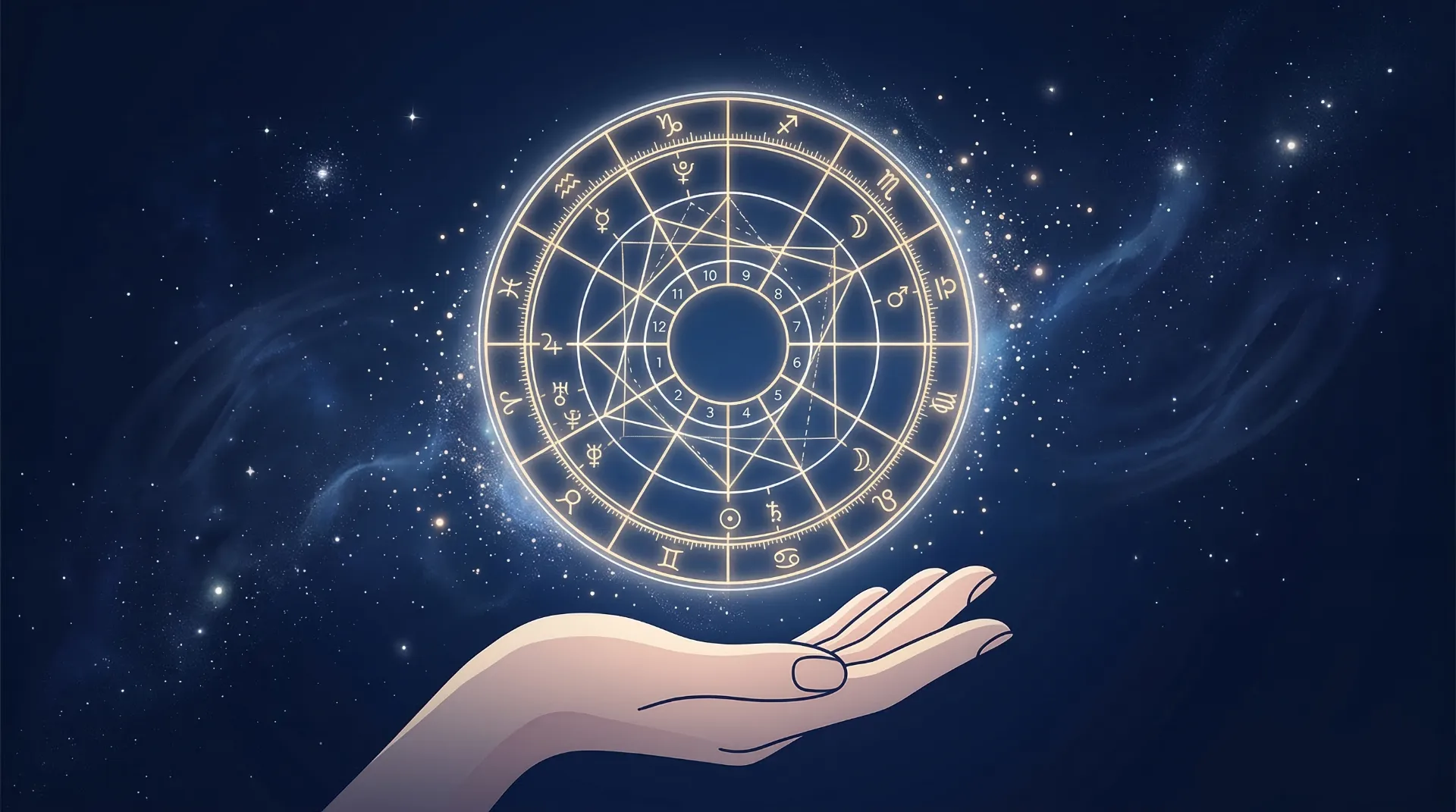
A birth chart is the most detailed astrological profile you can get — far more specific than your sun sign alone. AI-powered birth chart readings have made personalized chart interpretation accessible to anyone, without waiting weeks for an astrologer appointment or paying $50-300+ per session.
This guide walks you through how AI birth chart readings work, what to expect, and how to get the most from the experience.
An AI birth chart reading combines two things: accurate astronomical calculation (where every planet was at your exact birth moment) and AI-powered interpretation that synthesizes multiple placements into a personalized reading.
Unlike traditional astrology apps that serve the same pre-written paragraph to everyone with Venus in Scorpio, an AI reading considers your Venus alongside your Moon sign, your 7th house ruler, relevant aspects, and current transits — then generates a response that integrates all of those factors.
The result is closer to sitting across from a professional astrologer than reading a generic horoscope.
Three pieces of information determine your chart's accuracy:
Your birth date determines the positions of all planets, especially your Sun sign and the slow-moving outer planets. This is the minimum requirement for any chart.
Your exact birth time is the most critical piece. It determines your rising sign (ascendant), which changes approximately every two hours and sets the entire house system of your chart. Without it, your Sun sign, Moon sign, and planetary aspects remain accurate, but house placements will be approximate.
Where to find it: Check your birth certificate — most include the time. If yours does not, contact the hospital or vital records office where you were born.
Your birth location (city and country) is needed to calculate the local horizon at your birth moment. Two people born at the same minute but in different cities will have different rising signs and house placements.
Provide your birth date, time, and location. The AI calculates your chart using astronomical ephemeris data — the same mathematical foundations used by professional astrologers.
Your natal chart is calculated instantly, showing all planetary positions across the 12 houses and zodiac signs. This includes your Big Three (Sun, Moon, Rising), all personal and outer planet placements, and the aspects between them.
This is what separates an AI reading from a static report. Instead of getting a one-time document, you can have a conversation:
The AI knows your full chart and synthesizes multiple placements in each answer. Ask a follow-up, and it builds on the previous context — just like a real conversation.
Once you understand the basics of your chart, you can go deeper:
| Factor | AI Birth Chart Reading | Professional Astrologer |
|---|---|---|
| Cost | Subscription-based, unlimited questions | $50-300+ per session |
| Availability | Instant, any time | Weeks-long waitlists for popular astrologers |
| Follow-up questions | Unlimited | Limited to session time |
| Depth per question | Good synthesis of multiple placements | Deep nuance with life context |
| Transit tracking | Real-time, always updated | Periodic check-ins |
| Best for | Learning your chart, daily insights, exploring placements | Complex life situations, deep psychological work |
AI readings are not a replacement for a skilled astrologer working through a complex life situation. But for most people exploring their chart — understanding their placements, tracking transits, checking compatibility — AI provides an excellent experience at a fraction of the cost and with zero wait time.
Not all AI astrology tools are equal. When evaluating any tool, check these factors:
The house system determines which zodiac sign rules each house in your chart. Placidus is the Western standard used by most professional astrologers. Some apps use less common systems like Porphyry without telling you, which shifts your house placements and changes the reading entirely.
The critical difference. Template-based readings look up each placement and serve a pre-written paragraph — everyone with the same placement gets identical text. AI synthesis considers how your placements interact with each other, producing readings unique to your specific chart combination.
Test any tool by asking a question that requires combining multiple placements. If the answer could apply to anyone with your Sun sign, the tool is template matching.
Readings developed with input from practicing astrologers tend to be more nuanced and credible than those trained purely on generic internet content. Ask whether astrologers were involved in building the interpretation framework.
A static report gives you one interpretation. A conversational tool lets you explore specific placements, ask clarifying questions, and go deeper on areas that matter to you. This is the core advantage of AI over traditional report generators.
For a detailed comparison of what separates the best tools, see our guide to the best birth chart AI chatbots in 2026. For a data-driven look at accuracy, read whether AI astrology is actually accurate.
Natal AI is built for depth. The free birth chart calculator generates your chart instantly, and the AI chatbot interprets it using models developed with input from practicing astrologers.
Placidus house system by default. The professional standard in Western astrology. You can switch systems if you prefer.
Conversational AI chat. Ask unlimited follow-up questions about any placement, transit, or compatibility question. No per-question charges.
Supportive, insight-focused tone. Astrology includes challenging placements and difficult transits. Natal AI frames these constructively — honest about the challenges, focused on growth.
Already have an account? Go to AI chat
For pricing details, visit our pricing page.
Want to understand your chart before diving in? Read our complete guide to birth chart reading or learn what your Sun, Moon, and Rising signs reveal about you.