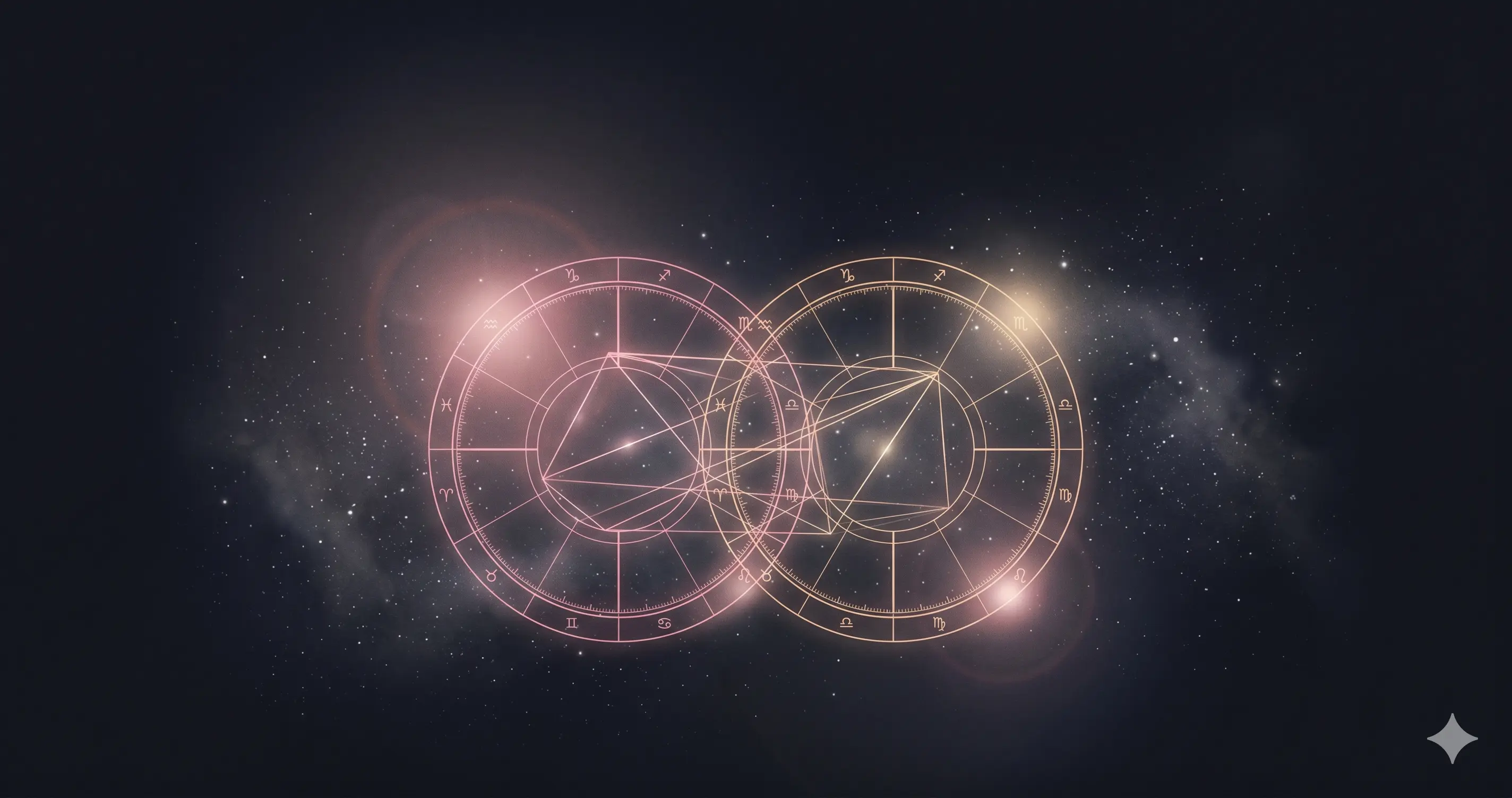
To read a synastry chart, you overlay two birth charts and work through four layers in order: overall element balance, each person's planets in the other's houses, the inter-aspects between the two sets of planets, and finally the heavyweight Saturn and outer-planet contacts. Reading in that sequence keeps you from drowning in detail and ensures you weigh the contacts that actually matter for a relationship.
This is the same method an astrologer uses. If you already understand what a synastry chart is, this guide is the practical "now what do I do with it" companion.
Before any single aspect, get a feel for the two charts together:
- Element balance — Two fire-heavy charts spark fast but can burn out; a fire-and-water mix runs hot and cold. Complementary elements often stabilize each other.
- Sun and Moon signs — Sun–Sun and Moon–Moon relationships hint at how naturally your core selves and emotional rhythms align.
This step tells you the "weather" of the relationship before you read the details.
This is the step beginners skip, and it's where synastry comes alive. Take Person A's planets and see which of Person B's houses they fall into — then reverse it.
- A's Venus in B's 7th house → A feels like partnership material to B.
- A's Mars in B's 5th house → A sparks romance, play, and desire in B.
- A's Saturn in B's 10th house → A influences B's ambitions and public life, for better or worse.
Planets-in-houses answer where one person activates the other's life.
Inter-aspects are the angles between your planets and your partner's. Read them in this order of importance:
| Priority | Contact | What it governs |
|---|
| 1 | Sun ↔ Moon | Core recognition, "I get you" |
| 2 | Venus ↔ Mars | Physical and romantic chemistry |
| 3 | Moon ↔ Venus/Moon | Emotional safety and affection |
| 4 | Mercury ↔ Mercury | Communication and mental rapport |